How to Choose an ERP Implementation Partner
Many failed ERP projects are blamed on the software, but the cause is often the implementation: the wrong partner, an unrealistic scope, or consultants who never understood the business.
This guide covers what a partner does and how to vet one before you sign, whether you’re implementing NetSuite, Business Central, or another mid-market ERP software.
What to evaluate in a partner:
- Fit (size, industry, location, and specific needs)
- Pricing and quote structure
- Delivery team and references
- Contract terms and post-go-live support
What Is an ERP Implementation Partner?
An implementation partner turns licensed software into a working system for your company. Their work includes:
- Configuration: Setting up the ERP
- Data migration: Moving your data over
- Integration: Connecting your other tools
- Testing and training: Testing the system and training your team
- Support: Helping after go-live, the day you officially switch over
Types of Implementation Partners
Sort partners by two questions: Do they sell the license? Do they do the implementation?
| Partner type | Sells the license | Does the implementation |
|---|---|---|
| Value-added reseller (VAR) | Yes | Yes |
| Implementation-only partner | No | Yes |
| Vendor’s own team (e.g., NetSuite) | Yes | Yes |
Some products, like Business Central, can only be bought through a partner.
How to Choose an ERP Implementation Partner
Evaluate Fit
Bigger isn’t always better. A 15-person firm with 40 food and beverage projects will usually outperform a 500-person generalist. A small firm may struggle with a global rollout.
- Size: Look for a partner that’s used to companies like yours, so you aren’t their smallest client and they don’t overbuild for you.
- Industry: They should already know terms like progress billing or lot traceability. Having to explain them is a red flag.
- Location: Matters mostly for time zones and on-site help at go-live.
- Specific needs: If you run several companies or locations, or you’re a manufacturer, ask when they last did a similar project.
Watch for Low Quotes
- A low quote can be a sales tactic: The partner wins the deal, then makes the money back through change orders after you sign.
- Change order: Any paid work outside the original scope, such as an extra integration or an unplanned report. Some are legitimate, but they add up fast, and you can’t shop around once you’ve signed.
- As a rule of thumb, implementation often costs about twice the annual software license. Compare quotes against each other, and ask any partner well below the rest to explain the gap.
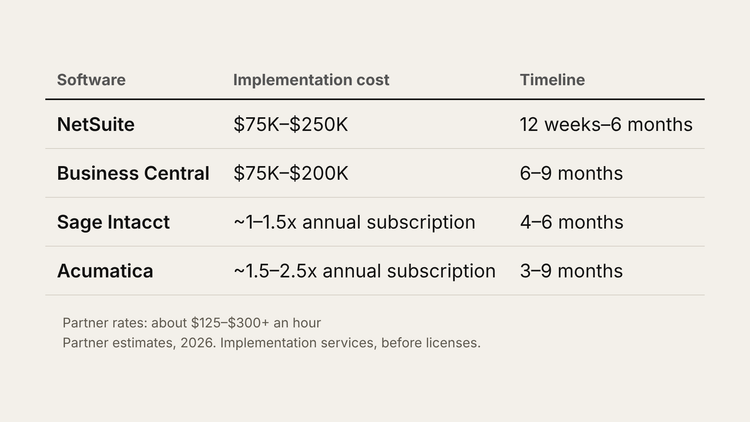
Compare Pricing Models
| Model | Benefits | Drawbacks |
|---|---|---|
| Fixed fee | Works well when scope is well defined | Partner prices in a buffer for overruns; anything outside written scope becomes a change order |
| Hourly | Tracks actual time; works better when scope is still changing | Final cost isn’t known up front; scope growth or delays add billed hours with no cap |
| Paid discovery phase | Partner maps your processes before pricing, giving a more realistic estimate | Adds an upfront cost before you have a full project quote |
Whichever model you choose, a wrong scope costs you. The model only decides how. Ask every partner:
- Exclusions: What’s excluded, in writing?
- Standard vs. custom: What’s standard setup, and what’s custom work?
- Your team’s time: How many hours do they expect from your team?
4 Tests to Run Before You Sign
- Meet the delivery team: Ask who your project manager and lead consultant will be, not just who’s selling to you.
- Talk to similar companies: On reference calls, ask about budget, timeline, whether the team changed, what they’d do differently, and how support is going now.
- Run a same-workflow test: Give each finalist the same real process and sample data. Have them show how they’d set it up and who owns it after go-live.
- Get details in the contract: Named team members, who’s responsible for what, and what happens if a key consultant leaves.
Additional Contract Terms
- Ownership: Document who owns each piece. Without it, a failed project can turn into a long legal dispute.
- Post-go-live support: Monthly retainer, block of hours, or pay as needed.
- Data and documentation: Make sure your data and setup documentation come back to you if you part ways.
- AI claims: If a partner pitches AI to speed up the project, ask how it affects timeline and price, and who checks the AI’s output.
Check Your Own Readiness
- The partner handles the build. You still own the decisions, data cleanup, and testing.
- Even the best partner can’t fix a team with no bandwidth.
- If a partner can’t name the people working on your project, connect you with clients in your industry, or tell you what’s excluded, keep looking.