

Best Aerospace & Defense Quality Management Software
We reviewed the top aerospace systems for manufacturers, defense contractors, and MRO operators for features, pricing, and industry fit. Explore our buyer’s guide covering AS9100 certification, ITAR compliance, and how to evaluate platforms for your aerospace and defense operations.

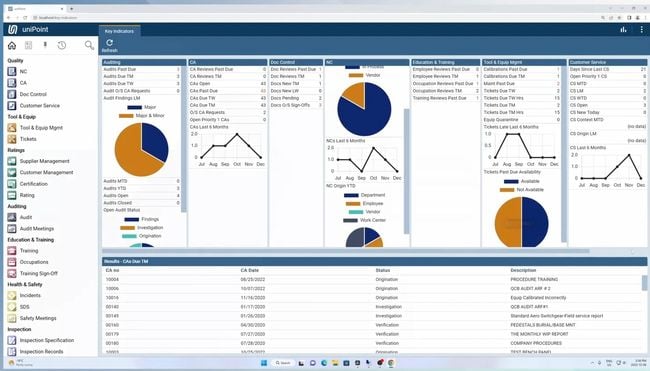
- Configurable, modular design with a variety of add-on modules
- Mobile-first design on uniPoint Web version
- Allows concurrent users rather than named seats
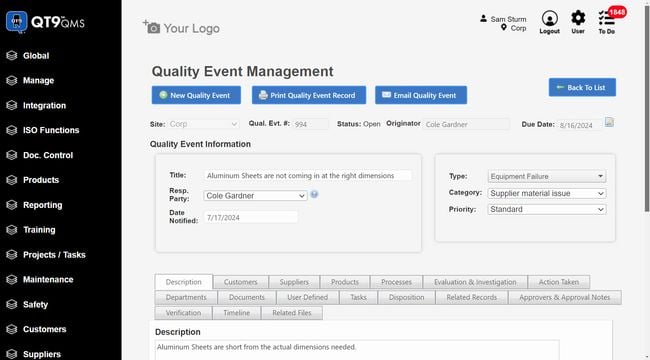
- Flexible deployment options with access on all devices.
- Has 25+ pre-installed modules for advanced functionality.
- Full validation included for life sciences companies.
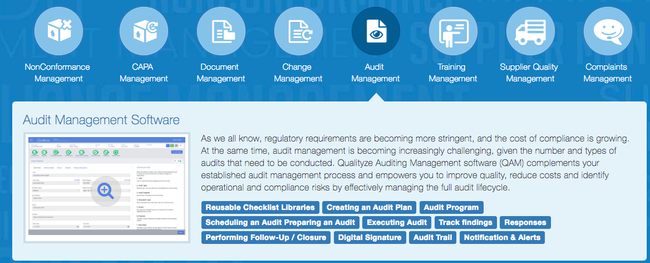
- Built onto the Salesforce platform
- Compliance covers a wide variety of regulations, including ISO 9001
- Integrated AI capabilities
Aerospace and defense QMS software goes beyond general quality management systems. AS9100 layers over 100 aerospace-specific requirements on top of ISO 9001 that generic platforms aren’t built to handle. We reviewed the top platforms for aerospace manufacturers, MRO operators, and defense contractors and suppliers below.
- UniPoint: Best Overall
- QT9 QMS: Best for Defense Contractors
- Qualityze: Best for Counterfeit Parts Traceability
- Octave Reliance: Best for Large Primes
- Unifize: Best for Job Shops
- Intellect QMS: Best for Global Quality Management
- Ideagen: Best for Aerospace Maintenance & MRO
UniPoint - Best Overall
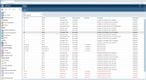
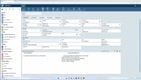
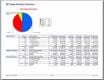
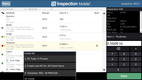
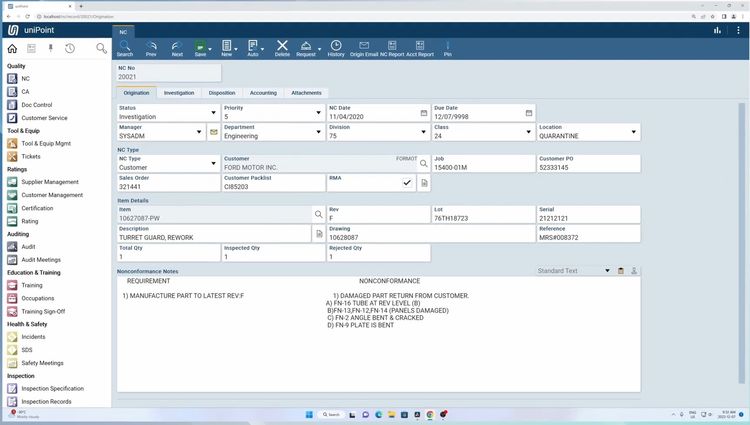
uniPoint is a QMS platform built for small and mid-market aerospace and defense manufacturers. It integrates tightly with over 50 ERP platforms and has modules covering full AS9100 compliance, including document control, CAPA, nonconformance management, auditing, supplier management, calibration, and training.
The platform streamlines first-article inspection (FAI) by automatically generating AS9102 forms 1, 2, and 3 each time. Using OCR, uniPoint automatically extracts critical data and GD&T symbols from your engineering drawings. From there, quality teams can verify if incoming materials and outgoing assemblies directly match the specifications captured from the original drawings. And if any nonconformances are detected, the system will instantly generate an NCR, linking the issue to the relevant inspection record and FAI for a complete, traceable audit trail.
Pricing for uniPoint is not publicly listed, though we estimate costs starting around $225/user/month. Add-ons and integrations are priced separately depending on your requirements. We recommend uniPoint to both small and large manufacturers struggling to manage quality with manual processes.
QT9 QMS - Best for Defense Contractors
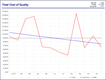
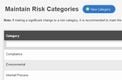
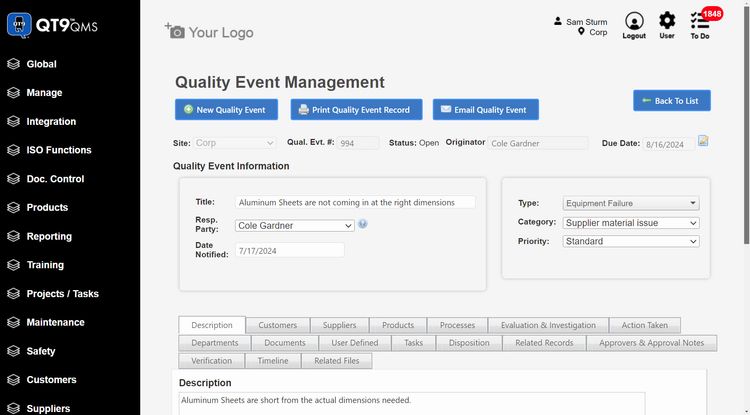
QT9 QMS is a complete QMS platform covering 28+ integrated modules across document control, CAPA, nonconformance management, auditing, supplier quality, training, and risk management. It serves aerospace and defense manufacturers of all sizes and is one of the few mid-market platforms to offer both cloud and on-premise deployment.
For defense contractors, that choice is the deciding factor as programs involving Controlled Unclassified Information or ITAR-controlled technical data require data to stay behind your own firewall. QT9’s on-premise option keeps your quality data on your own servers while delivering the same full module set as the cloud version, including electronic signatures, automated audit trails, and version-controlled document approvals that hold up under AS9100 and CMMC scrutiny.
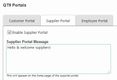
The platform also includes a supplier portal where sub-tier suppliers can upload certifications, respond to corrective action requests, and update performance data directly. This reduces the manual back-and-forth that slows down supplier qualification on defense programs. All supplier interactions are logged and linked to the relevant nonconformance or CAPA record.
QT9 starts at $2,200/concurrent user/year, with implementation and initial training priced separately. It is a strong fit for Tier 2 defense suppliers managing AS9100 alongside ITAR or CMMC requirements. Companies needing deep ERP integration beyond QT9’s own MRP will want to confirm connector availability before purchasing.



Qualityze - Best for Counterfeit Parts Traceability
Qualityze is a cloud-based eQMS built natively on Salesforce, covering AS9100, ISO 9001, and IATF 16949. It includes document control, CAPA, nonconformance management, supplier quality, audits, and training, making it a great fit for aerospace and defense manufacturers and industrial manufacturers.
Counterfeit parts are one of the few quality failures in aerospace that can permanently end a supplier relationship. Qualityze addresses this by tracking every part from the original procurement record through to final production, so you can trace exactly where a component came from, who approved it, and which inspections it passed. If a suspect part is flagged, configurable quarantine workflows kick off automatically, linking the issue to the originating supplier record and triggering a corrective action before anything moves further down the line.
That same supplier linkage extends to ongoing performance. Scorecards and SCAR management keep sub-tier supplier quality visible over time. So when an OEM auditor asks how you’re controlling your supply chain, the documentation is already there rather than something your team has to scramble to produce.
Pricing is not publicly listed and requires a custom quote. Qualityze is a strong fit for mid-size to large aerospace manufacturers. Teams without dedicated IT resources may want to factor in implementation support when budgeting, as initial setup can be more involved than simpler out-of-the-box platforms.

Octave Reliance - Best for Large Primes
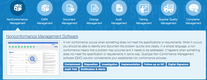
Octave Reliance (formerly ETQ Reliance) is an enterprise cloud-based eQMS built for large multi-site manufacturers. It’s widely used across aerospace, life sciences, and industrial manufacturing, and is one of the more established platforms in the Tier 1 and prime contractor space.
The platform’s 40+ no-code applications cover AS9100, AS9110, and AS9120, making it one of the few options that can manage quality processes across manufacturers, MRO operators, and distributors under one system. Using the easy-to-use drag-and-drop builder, quality teams can configure custom workflows, forms, and escalation rules without involving IT. Once workflows are created, the changes can be pushed to all locations. That means if a nonconformance is raised at one facility, the same CAPA workflow and root cause analysis framework are followed every time, giving large defense primes consistent audit results.
Pricing for Octave Realiance is quote-based and scales based on users, modules, and the number of locations. The platform integrates well with ERP, MES, and PLM systems, making it a great choice for larger organizations with existing software. That said, smaller operators may find its features too complex for basic needs.
Unifize - Best for Job Shops
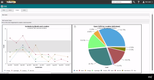
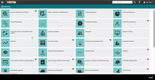
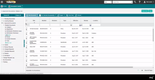
Unifize is a cloud-based platform that combines document management, QMS, PLM, and MES into a single system. It supports ISO, FDA, and ITAR-regulated manufacturers, and is built to work for large teams as well as for operations as small as 10 people.
Smaller aerospace job shops often have no system in place and need more than just quality management when they finally make the move to software. Unifize covers that ground by offering quality, product, and production workflows under one software, without the cost and complexity of stitching together disparate systems. And on top of that, the no-code configurator and chat-based interface mean the platform can be up and running quickly, even without dedicated IT or quality staff.
Packages start at $1,000/month, billed annually, and are built from a combination of the products you select, so you pay for what you need. Costs will increase with the number of modules and users, so factor this in as your shop grows. And because Unifize is cloud-only, defense contractors with strict CUI data-residency requirements will need to evaluate whether it meets their program obligations.



Intellect QMS - Best for Global Quality Management
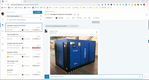
Intellect QMS is an AI-powered, quality management platform built for mid-market and enterprise manufacturers. It covers AS9100, ISO 9001, FDA, and over nine other regulatory frameworks through over 30 pre-built applications. It offers cloud hosting at local data centers available across most international markets.
For aerospace manufacturers operating throughout multiple sites or regulatory jurisdictions, Intellect lets quality teams configure applications for each compliance framework without running separate systems by region. The platform’s AI Smart Analysis tool lets quality managers quickly surface root causes, flag recurring nonconformance patterns, and generate audit reports on demand using natural language. For a global quality team managing multiple programs and sites, that means less time pulling reports by hand and faster responses when regulators ask for more evidence.
Pricing starts at $19,000/year for the Pro plan with Enterprise pricing starting at $39,000. Intellect is best for mid-size to large organizations operating across different regions and compliance standards. Smaller organizations may find its pricing too steep for simple operations or single-standard compliance needs.

Ideagen - Best for Aerospace Maintenance & MRO
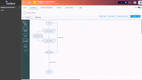
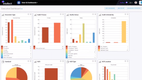
Ideagen Quality Management is an eQMS built for highly regulated industries, with strong adoption across aviation maintenance and MRO. It covers document control, nonconformance management, audits, safety reporting, and employee training, and is available for cloud-based or on-premise deployments.
MRO operators face a unique quality challenge. Technicians must work from approved procedures, certifications must be documented before anyone touches an aircraft, and every finding must have a clear paper trail. Ideagen manages all of that in one place. Procedures stay version-controlled, certifications are tracked against each technician, and nonconformances are linked to corrective actions so nothing gets lost. And with the Ideagen mobile app, technicians can log findings and incidents directly from the shop floor, even while offline.
Ideagen is best suited for mid-size to large MRO operations. The interface is not the most intuitive, and users report a learning curve when configuring workflows and managing records. So, smaller operations should factor in onboarding time before committing. Pricing for Ideagen requires a custom quote that scales based on required capabilities and user counts.




What is Aerospace and Defense Quality Management Software?
Aerospace and defense QMS software is purpose-built to meet the quality, traceability, and regulatory requirements of companies that design, manufacture, maintain, or distribute aviation, space, and defense products. It goes significantly beyond generic ISO 9001 quality management tools, which are designed for general manufacturing and service businesses.
AS9100D (soon to be IA9100) is the primary quality standard that governs aerospace and defense manufacturers. It layers over 100 aerospace-specific requirements on top of the general ISO 9001, covering product safety, configuration management, inspections, counterfeit parts control, and supplier oversight, which are not currently addressed in standard QMS software.
The IA9100 revision is expected to be published in late 2026 alongside ISO 9001:2026. It will strengthen information security requirements, expand APQP and ethical leadership provisions, and introduce more explicit sub-tier supplier controls.
Aerospace and Defense Quality Standards and Regulations
AS9100 is the foundation, but it’s rarely the only standard in play. Most aerospace companies carry additional compliance obligations depending on what they make and who they sell to. Use the table below to identify which applies to you before evaluating platforms.
| Standard | What It Covers | Who It Applies To |
|---|---|---|
| AS9100D (IA9100) | The baseline QMS standard for aerospace manufacturing. Adds product safety, configuration management, and supplier oversight to ISO 9001. | All aerospace/defense product manufacturers and suppliers |
| AS9110 | Adds airworthiness documentation, task card management, and return-to-service certification requirements not present in AS9100. | MRO operators, repair stations, and airline maintenance organizations |
| AS9120 | Focuses on parts traceability, documentation control, and counterfeit parts prevention in the distribution chain. | Aerospace parts distributors and stockists |
| AS9102 | Defines three standardized forms (Forms 1, 2, and 3) for verifying that first production parts conform to all engineering design requirements. | Manufacturers producing a new or modified production part for an aerospace customer |
| AS9145 | Governs Advanced Product Quality Planning (APQP) and Production Part Approval Process (PPAP) for new program launches. | Suppliers required by OEMs to submit PPAP documentation before production approval |
| NADCAP | Special process accreditation for welding, heat treatment, NDT, and chemical processing. Administered by the Performance Review Institute. | Suppliers performing NADCAP-designated special processes for aerospace primes |
| ITAR | US export control regulation governing the transfer of defense-related technical data, hardware, and services. Restricts where data can be stored and who can access it. | US defense contractors, manufacturers, and exporters of USML-listed articles or technical data |
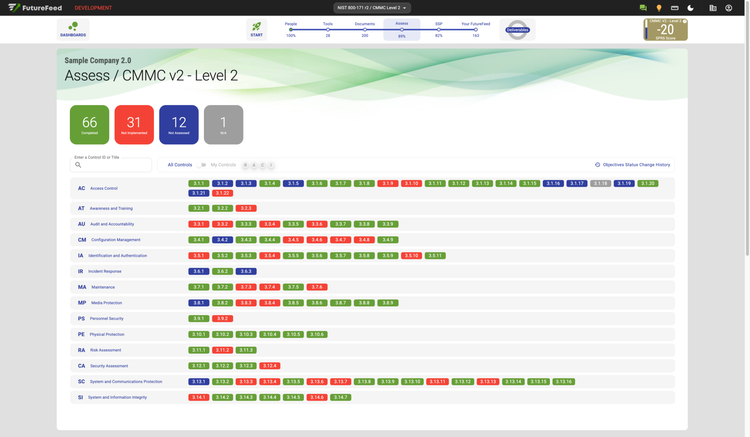
| CMMC Level 2 | Verifies implementation of all 110 NIST SP 800-171 security controls for systems that store or transmit Controlled Unclassified Information. | Defense contractors and subcontractors with CUI in their information systems |
| CMMC Level 3 | Builds on Level 2 by adding 24 enhanced security requirements from NIST SP 800-172, targeting advanced persistent threats on high-priority DoD programs. | Defense contractors on critical programs designated by the DoD as requiring elevated cybersecurity controls |
How Aerospace and Defense Certification Works
AS9100 certification follows a structured sequence. Most organizations complete the process in six to twelve months, depending on the maturity of their existing quality management system and the complexity of their operations.
The steps:
-
Gap analysis: Compare your current QMS against all AS9100 requirements to identify documentation gaps, missing process controls, and areas requiring corrective procedures.
-
Policy and documentation development: Build or update your quality manual, work instructions, procedures, and forms to cover every applicable AS9100 clause.
-
System implementation: Run your QMS for at least three months, collecting records and training employees on new workflows.
-
Internal audit: Conduct a full internal audit against AS9100 before engaging a certification body. Non-conformities found here must be resolved and documented.
-
Management review: Top management formally reviews QMS performance, audit results, and quality objectives.
-
Stage 1 certification audit: A third-party certification body (CB) reviews your documentation for completeness and compliance. Any gaps must be resolved before Stage 2.
-
Stage 2 certification audit: The CB audits your facility, interviews staff, traces work examples through your system, and verifies implementation. Successful completion results in your AS9100 certificate, valid for three years with annual surveillance audits.
Once certified, your organization is listed in the IAQG OASIS database. Aerospace prime contractors and OEMs can look up any supplier’s certification records and expiration dates. Visit IAQG OASIS website to search the database or verify your listing after certification.
Key Features of Aerospace and Defense QMS Software
When evaluating quality management software, these are the core capabilities you should look for:
- Document Control: Stores and manages version-controlled procedures, work instructions, and quality records with electronic signatures, providing the audit trails for required AS9100 certification.
- CAPA and NCR Tracking: Manages corrective and preventive actions from nonconformance through root cause analysis to documented closure, with automated escalation for approaching due dates.
- Supplier Quality Management: Monitors and documents supplier performance through incoming inspection records, scorecards, CAPA linkages to supplier-originated NCRs, and a portal for communicating corrective action requests to sub-tier suppliers.
- Audit Management: Automates internal audit scheduling, clause-based checklists, and finding tracking through to closure for AS9100 surveillance and recertification audits.
- Calibration Management: Tracks calibration due dates, stores certificates, and links calibration records to inspection data for all measurement and monitoring equipment per AS9100 Clause 7.1.5.
- Training Management: Assigns training by role, tracks electronic completion acknowledgment, and sends expiration alerts to maintain documented competency records for quality-affecting personnel.
- Risk Management and FMEA: Supports Failure Mode and Effects Analysis, operational risk assessments, and linkage between identified risks and the process controls or CAPA actions that address them.
- Configuration Management: Tracks which revision of a drawing, specification, or engineering change order was active when a given part was produced, per AS9100 Clause 8.1.2.
- Cloud and On-Premise Deployment: Supports both cloud and on-premise hosting to accommodate commercial aerospace suppliers and defense contractors with ITAR or DFARS data residency requirements.
Aerospace and Defense QMS Required Features
Generic systems cover the core foundations of quality management like document control, nonconformance tracking, CAPA, and internal audits. What they don’t cover are the aerospace-specific requirements, including:
- FOD (Foreign Object Debris/Damage) control: Documented processes to prevent foreign object contamination during manufacturing and assembly.
- First Article Inspection (AS9102): Generates and tracks AS9102 Forms 1, 2, and 3, verifying that first production parts conform to all engineering design requirements, including key characteristic tracking per AS9103.
- Counterfeit parts management: Controls to detect and prevent suspect unapproved parts from entering production, per AS9100 Clause 8.1.4.
- Sub-tier supplier oversight: Documented flow-down of quality requirements to your suppliers’ suppliers, with portal capability to communicate and track corrective actions.
- Post-delivery escape reporting: When a nonconforming product has already shipped, AS9100 Clauses 8.4.3 and 8.7 require external customer notification, documented evidence, and formal corrective action (not just internal).
- CMMC cybersecurity layer: Defense suppliers handling CUI must meet CMMC requirements that no generic ISO 9001 platform addresses.
Cloud vs. On-Premise Deployment
For aerospace and defense companies, where your QMS data lives is not just an IT decision. Choosing between cloud-based and on-premises software will directly affect which vendors you can legally use, how quickly you can implement, and whether your system will pass customer or government audits.
-
Cloud-based QMS software is hosted on the vendor’s servers and accessed through a web browser. The vendor manages updates, security patches, and infrastructure. There’s no hardware to purchase or maintain, and implementation is typically faster.
-
On-premise QMS software is installed and hosted on your own servers, inside your facility or private network. Your IT team manages the infrastructure, updates, and security. Setup takes longer and requires more internal resources, but your data never leaves your controlled environment.
Defense contractors under DFARS 252.204-7012 must ensure that any external cloud service provider used to store, process, or transmit covered defense information meets FedRAMP Moderate baseline equivalency. On-premise systems are not subject to FedRAMP; they must instead meet NIST SP 800-171 requirements. If your programs involve CUI and you intend to use a cloud-based QMS, verify that the vendor holds FedRAMP Moderate authorization.
| - | Cloud | On-Premise |
|---|---|---|
| Commercial aerospace (AS9100) | Yes | Optional |
| MRO / AS9110 | Yes | Optional |
| Defense contractor with CUI | Only if FedRAMP authorized | Yes |
| ITAR-controlled programs | Verify with legal counsel | Yes |
Pricing Guide
Aerospace QMS pricing can range from $5,000 to over $150,000 per year. Costs vary based on company size, required features, and operational complexity. Most vendors don’t publish list prices and require a demo call before providing a quote.
The ranges below reflect the total annual cost of ownership based on company size.
| - | Company Size | Annual TCO | Example Vendors |
|---|---|---|---|
| Small shop | 1–25 employees | $5,000–$15,000/yr | IntellaQuest, QT9 QMS |
| Mid-market | 25–150 employees | $20,000–$50,000/yr | QT9 QMS, ComplianceQuest, Intelex |
| Large mid-market | 150–500 employees | $50,000–$150,000/yr | MasterControl, Octave Reliance |
| Enterprise | 500+ employees | $150,000+/yr | Octave Reliance, MasterControl, SAP QM |
-
On-premise and defense hosting: FedRAMP-authorized or on-premise deployment adds server, managed hosting, or GovCloud costs on top of the subscription price.
-
Implementation costs: Plan for additional first-year costs on top of your initial license for configuration, migration, and staff training. Small shops without in-house quality staff should also budget for an AS9100 consultant.
How to Choose an Aerospace and Defense QMS
Aerospace QMS software can vary heavily depending on your unique business requirements. Use these questions to identify which platforms are actually built for your situation:
Does it cover your specific standard?
Confirm each QMS you evaluate has coverage for your specific standard. While AS9100 is the baseline for the industry, distributors need to comply with AS9120, manufacturers will need AS9102, and MRO providers will need AS9110. Not every platform will cover each standard equally.
Where does your data need to live?
If your programs involve Controlled Unclassified Information or ITAR-controlled technical data, cloud deployment may be restricted or prohibited. Ask vendors directly whether their platform is FedRAMP authorized or available on-premise. An “ITAR compliance statement” is not the same as FedRAMP authorization.
What integrations does it offer?
Ask vendors whether the integrations for the systems your team already uses are native, API-based, or dependent on middleware. These could include an ERP, PLM, and MES. A QMS that doesn’t integrate with your existing stack requires manual data entry and increases audit failure.
What is the implementation timeline?
If you’re working toward a customer-imposed certification deadline, ask vendors what “pre-configured AS9100 templates” means in practice. Understand how much configuration is still required, and who is responsible for the extra work. Implementation timelines vary significantly by which platform you select.
Can it scale as we grow?
Confirm whether multi-site functionality is included or a paid add-on, and how pricing scales as you grow. A platform that fits a 15-person shop today may not handle multi-site document control in three years.