

IDU Software

We like that IDU ties budgeting, forecasting, and reporting directly to your ERP, so managers plan against live figures instead of waiting on finance for a spreadsheet. We also like that multi-entity and multi-currency consolidations roll up complex group structures without manual entries. A new feature we liked was the AI Insight Agent, which reads your numbers and explains variances in plain language so you catch issues sooner.
We would not recommend IDU to small teams that only need basic bookkeeping or plan to run budgeting entirely on spreadsheets. Smaller organizations may not use all their features, and setup can take longer than more basic tools. IDU doesn’t publish pricing, and implementation is billed separately unless you choose the SaaS pricing plan.
Mid-market and enterprise finance teams (50-10,000+ employees) that need integrated budgeting, forecasting, reporting, and multi-entity consolidation beyond what an ERP can offer.
Great for department managers who enter and manage their own budgets.
- AI Insight Agent explains variances and anomalies in plain language
- Multi-company and multi-currency support
- Flexible deployment options
- Multiple native ERP integrations
- Reduces reliance on excel
- Advanced dashboards require additional setup and training
- Setup and administration require finance involvement
- Steep learning curve
- Developer IDU
- Client OS Web
- Deployment Cloud or On-Premises
What Is IDU?
IDU (formerly IDU-Concept) is a financial planning and analysis (FP&A) platform that connects budgeting, forecasting, and reporting to your ERP so managers plan against the same live numbers as finance. Beyond that core, it handles specialized planning for capex and cash flow, multi-entity consolidations, asset and loan management, and AI tools that flag variances for the month-end close. IDU offers flexible hosting options and can be deployed on-premise, in your own cloud, or fully managed by IDU.
Our team had the opportunity to explore the software firsthand during a demo session with an IDU representative. We assessed its scalability, performance, usability, and value for money.
Our Ratings
| Usability - 7.5 | IDU is built for operational managers, not just finance, so department heads can capture and adjust their own budgets through a guided interface, rather than routing every change back through the finance team. The included AI Help agent answers questions on-screen to shorten onboarding, though advanced reporting and dashboard setup still take time to learn. |
| Support - 9.5 | Customer feedback primarily drives feature development. And defined SLAs provide a clear, accountable path for support when something breaks, though coverage is during business hours, not 24/7. |
| Scalability - 8.5 | Enables multi-entity and multi-currency consolidations with automatic intercompany eliminations, and a month-end close that takes days instead of weeks. IDU connects to most ERP systems and can be deployed on-premise, in your cloud, or as a fully managed offering, with options to scale. |
| Security - 10 | Supports role-based access, single-sign on( SSO), and multi-factor authentication (MFA) along with a timestamped, attributed audit trail for audit purposes. Data is encrypted in transit and at rest on Azure, with POPIA-aligned data practices. |
| Value - 7.5 | Reduces budgeting cycles from months to weeks, with most rollouts live in three to six weeks; flexible per-user licensing spans capital, subscription, managed, and month-to-month; pricing isn't published, and implementation is priced separately unless bundled in the SaaS-managed plan. |
| Performance - 8 | Budgets and forecasts update live as managers enter figures, and reporting drills from group total to GL transaction. ERP actuals sync on a schedule, typically daily, so budget-vs-actual reflects daily budgets. |
| Key Features - 10 | Provides budgeting, forecasting, consolidations, reporting, fixed asset management, and S&OP , plus predictive forecasting and AI agents for in-platform help and advanced finance analysis. Integrates natively with most ERP systems and exports to Excel and Microsoft Power BI. |
Who Uses IDU?
IDU is built for mid-sized to large organizations that have outgrown spreadsheet budgeting, particularly those with multiple entities, departments, or cost centers to plan and consolidate. It connects finance teams with the operational managers who own the budgets, rather than keeping planning locked inside the finance department. Though industry agnostic, IDU has a strong footprint in financial services, education, mining, and the nonprofit and public sector, and serves more than 500 organizations across four continents.
IDU Features
IDU brings budgeting, forecasting, reporting, and financial consolidation into a single platform, directly connected to your ERP.
-
Budgeting and planning: Managers build and adjust their own budgets through a guided web interface, with support for line-item, driver-based, capex, and scenario approaches in the same model. Finance sets top-down targets and validation rules, while managers fill in the bottom-up details, so the two reconcile without merging spreadsheets or chasing versions via email.
-
Forecasting with predictive AI: Forecasts can start from predictive assumptions that the system trains on your own historical data. You control the confidence level and the historical window it learns from, and every suggested figure remains editable, so finance keeps a defensible baseline it can still override line by line.
-
Multi-entity consolidations: Each subsidiary submits in its own currency and chart of accounts, and IDU matches and eliminates intercompany balances automatically, then applies currency translation at the account level. What used to take a week or two of manual reconciliation becomes a group result in a couple of days, and you can drill from the group total down to the originating transaction for audit.
-
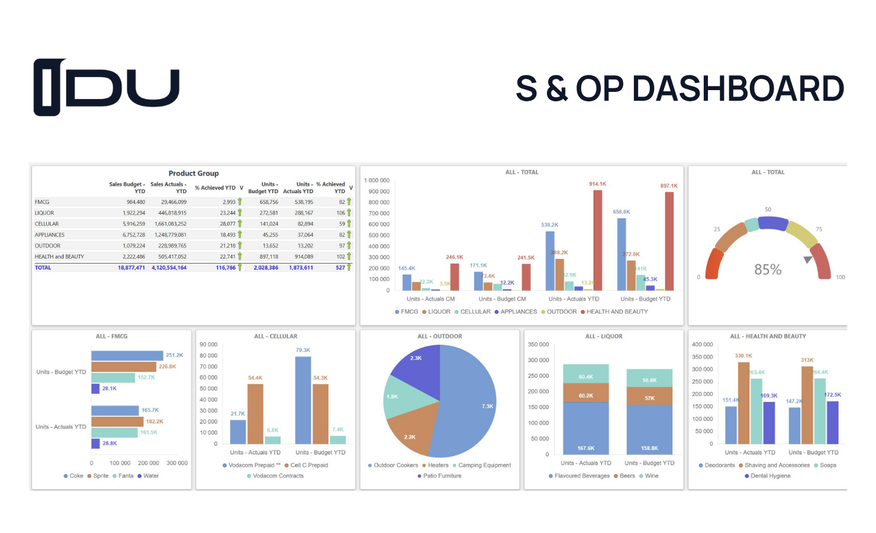
Reporting and analytics: Interactive reports and dashboards let users move from group-level summaries down to individual GL transactions. Results can be exported to Excel or Power BI, letting operational managers answer budget questions without waiting for finance to pull a report.
-
Fixed asset management: IDU integrates with your existing asset register rather than replacing it, tracking capital spend, depreciation impact, and lifecycle events against the financial plan. Teams can verify assets in the field by scanning QR codes on a smartphone, without barcode scanners or specialized hardware.
-
AI Insight agent: An AI agent that reads budgets, forecasts, and actuals to highlight variances, trends, and anomalies. The agent can explain what is changing in plain language, helping both finance and operational managers catch issues before the month-end close.
What Features Are Missing?
-
Approachability: IDU covers a lot of ground, and new users, especially non-finance managers, need some time and training before they are comfortable moving around the platform. Advanced reporting and dashboard configuration, in particular, take some setup to get right. The planning model is also defined and governed by finance, which keeps it consistent across the business, but it also means managers work within the structure and rules that finance sets, rather than building their own.
-
Transparent pricing: IDU does not list pricing publicly, so there is no quick way to gauge cost without a scoping conversation. Licensing is per user across three editions and several models, and implementation is quoted and billed separately unless you choose the all-inclusive managed plan. For a smaller organization budgeting tightly, those separate implementation and hosting costs can push the total higher than the per-user license figure alone suggests.
IDU Pricing
IDU is licensed per user across three editions, Light, Standard, and Enterprise, so you only pay for the depth of functionality your team needs and can add features or move up as requirements grow. Exact figures are provided on request, based on your edition, user count, and deployment.
On top of the edition, you must choose a licensing model that fits your budgetary needs:
-
Classic license: A once-off license purchase with annual usage and maintenance fees.
-
Subscription: A recurring fee paid monthly or annually. With implementation scoped separately.
-
Software-with-a-Service: One monthly fee bundling software, hosting, and implementation together.
-
SaaS-Flexible: A month-to-month option with the ability to change the number of paid users during peak cycles.
Implementation is scoped and billed separately for most plans. Factors that affect your total cost include:
- Number of users and the edition each requires
- Deployment choice: on-premise, your own cloud, or IDU-managed
- Implementation scope, ERP integration complexity, and data readiness
- Optional add-on modules such as consolidations, analytics, and alerts
Alternatives
Summary
We like that IDU connects budgeting, forecasting, and reporting to your ERP, so managers plan against live actuals instead of waiting on finance for a spreadsheet. Its multi-entity, multi-currency consolidations turn subsidiary submissions into consolidated results in days, with transaction-level drill-downs. We also like its flexible deployment options, new AI agents, and support for global operations.
Despite its strengths, IDU can pose a learning curve for users unfamiliar with detailed planning software, and advanced reporting and dashboard configuration take setup to get right. Pricing is not published, and implementation is scoped and billed separately unless you take the managed plan, so smaller organizations should weigh the full cost of ownership before committing.
This platform is a strong fit for mid-sized to large businesses with multiple entities, departments, or cost centers that have outgrown spreadsheet budgeting and want finance and operational managers working from the same numbers. Combining ERP-connected planning with real-time visibility and predictive AI, IDU is a capable financial planning and analysis solution for organizations ready to move beyond disconnected spreadsheets.
User Reviews of IDU Software
Write a Review
The implementation and follow up support was excellent
Overall: The implementation and follow up support was excellent, meeting a short deadline on time. Pros: The product is powerful and easy to use and the customer support was excellent Cons: It does everything we need and a whole lot more beside. There is nothing I dislike. Reasons for Choosing IDU-Concept: Overall easy of use and value for money Reasons for Switching to IDU-Concept: Cost
The ease of use of the system
IDU has been easy to use with there staff always being helpful to resolve any queries or develop new reporting requirements.
The ease of use of the system which allows for quick access to actual results and the detailed budget plus gives the ability to add as many forecast that are required. The ability to customize the system for specific reporting needs. The chart and matrix functionality.

- Internet Software & Services
- 51-250 employees
- Annual revenue $10M-$50M
An extremely valuable financial management tool
An extremely valuable financial management tool.
Pros
Information is easily accessible. Collaboration functionality make queries simple. Rapid forecasting features allow for better time management.
Cons
Nothing, its a pleasure to use internally compared to other finance solutions.