

Tulip Interfaces
1 Review 5/5 ★ ★ ★ ★ ★A no-code frontline operations platform and composable MES for manufacturers with in-house engineers to build apps.
Product Overview
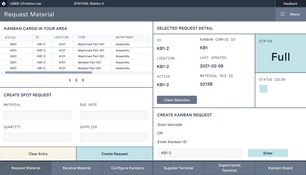
Tulip Interfaces, an MIT spinout, makes Tulip, which manufacturers use to build their own shop-floor apps for work instructions, quality checks, production tracking, and traceability.
The Tulip Platform differs from a traditional manufacturing execution system (MES) in how it gets built. Instead of configuring fixed screens, engineers assemble apps, data tables, and machine connections, then update them as the process changes. It runs as cloud software on off-the-shelf hardware rather than proprietary stations.
Pros
- Engineers build shop-floor apps without waiting on IT
- Pricing is published per interface, billed annually
- Regulated plan adds 21 CFR Part 11 e-signatures
Cons
- Interface minimum makes small pilot rollouts costly
- Complex logic usually needs a dedicated app builder
- Analytics can’t combine data across multiple tables
Target Market
Mid-size and large manufacturers in discrete assembly, pharma, and medical devices. Works best for plants starting with digital work instructions or quality checks.Not Recommended For
Small shops without engineering time to maintain apps, or for plants that mainly need machine monitoring or an out-of-the-box MES.Video Overview
Key Features
No-Code App Builder
- Build guided workflows, operator terminals, and dashboards in a drag-and-drop editor, with app logic set through triggers.
- Start from app suites, widgets, and connectors in the Tulip Library.
- Map how an app’s steps and logic connect with App Diagrams.
Digital Work Instructions
- Run step-by-step instructions on tablets, desktops, touchscreens, and wearables.
- Download training and kitting apps from the Tulip Library.
- Convert PDFs, SOPs, and videos into apps with AI Composer.
- Translate apps into other languages with one click.
Quality and Inspection
- Log nonconformances and run inline quality checks.
- Read barcodes, DataMatrix codes, and printed text with standard USB or IP cameras.
- Flag visual defects with custom anomaly detection models trained through an integrated third-party service.
Tables and Analytics
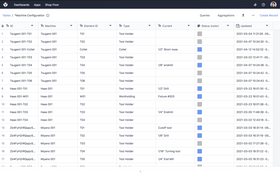
- Store production data in Tulip Tables, shared across apps.
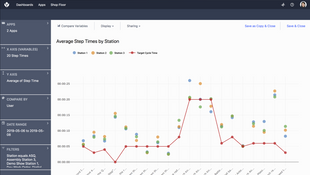
- Build real-time charts and add them to apps and dashboards.
- Tulip sets no hard cap on records but limits API writes to 10 per second per table.
Machine and Device Connectivity
- Connect USB devices, such as barcode scanners.
- Use general-purpose input/output (GPIO) and Tulip edge devices.
- Pull machine data over OPC UA and MQTT, and write values back to machines from apps.
ERP and System Integrations
- Connect to databases and web services with SQL and HTTP connectors.
- Reach on-site systems through an on-premise connector host, and build custom integrations with the Tulip API.
- Start from library connectors for SAP S/4HANA, NetSuite, and Oracle Fusion, which need extra configuration.
- SAP ECC requires middleware, and NetSuite requires a script deployed inside NetSuite.
AI Tools
- Answer operator questions with AI Chat, which draws on manuals, SOPs, and system data.
- Capture notes with speech-to-text and check labels with optical character recognition (OCR).
- Configure AI agents that watch production data and take defined actions. Agents are currently in beta.
Regulated-Industry Compliance
- Keep GxP and AS9100 audit history, with a validation pack and Long-Term Support releases.
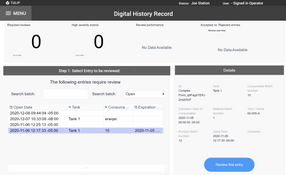
- Use prebuilt apps for electronic batch records, device history records, weigh and dispense, logbooks, and line clearance.
- Handle controlled unclassified information in a FedRAMP Moderate Equivalent environment.
Tulip MES Pricing
Tulip publishes prices for two of its four plans. Essentials costs $100 per interface per month and Professional costs $250. Enterprise and Regulated Industries are quote-based. Every plan requires at least 10 interfaces, and Essentials caps out at 50.
At the minimum, software alone runs about $12,000 a year on Essentials ($36,000 over three years) and $30,000 a year on Professional ($90,000 over three years). A plant at the Essentials cap of 50 interfaces pays about $60,000 a year.
Factors that affect pricing:
- Active interfaces. Tulip counts any device that runs a Tulip app on at least one day in a month.
- Plan tier. SQL and HTTP connectors, the Tulip API, SSO, custom widgets, GPIO, and edge devices require Professional or higher.
- Add-ons. Machine Monitoring, computer vision, extra AI Actions and automations, AWS GovCloud, a FedRAMP environment, professional services, and premium support cost extra. Tulip doesn’t publish add-on prices.
- AI quotas. Monthly AI Actions run 250 on Essentials, 500 on Professional, and 1,000 on Enterprise and Regulated Industries.
Frequently Asked Questions
Is Tulip an MES?
Does Tulip offer a free trial?
Product Overview
Developer Overview
Related Products


User Reviews of Tulip Interfaces
Write a Review
Tulip helps us determine the root cause of problems
We implemented this system together with our operators. Including them in the process from the start has been a great success.
The Tulip software helps digitize shop floor processes that vary by customer. The intuitive software is flexible and easy to configure, making it a sustainable and scalable solution.
We use Tulip at every DMG MORI site. Each site has a different focus. At DECEL-MAHO Pfronten we focus on the production of motor spindles.
Tulip provides timely information to operates and can be installed quickly on the shop floor. A complicated data network is not required. After four weeks, we gained insight into how we could significantly reduce errors and stabilize production.
Our spindle line assembly consists of over 16 stations. It’s important that the operator knows exactly which task they need to perform to complete the job. Tulip supports this 100%.
Now there’s live information from the operators and stations and we know where improvement is needed in order to reduce errors.
Tulips helps us identify the root cause of problems. It’s easy to configure with no programming skills required. This helps us reflect daily changes tor requirements.
Tulip helps us determine the root cause of problems with absolute certainty.
