

NetSuite Pricing: Real Costs & Ranges
Google Oracle NetSuite pricing, and you’ll find ten different numbers from ten different sources. That’s because, like most ERP software, NetSuite doesn’t have a fixed cost–it has a pricing structure that compounds over time.
In this article, we’ll explore NetSuite’s pricing model, how it actually works, and ballpark ranges for base licenses and user pricing.
How NetSuite Pricing Actually Works
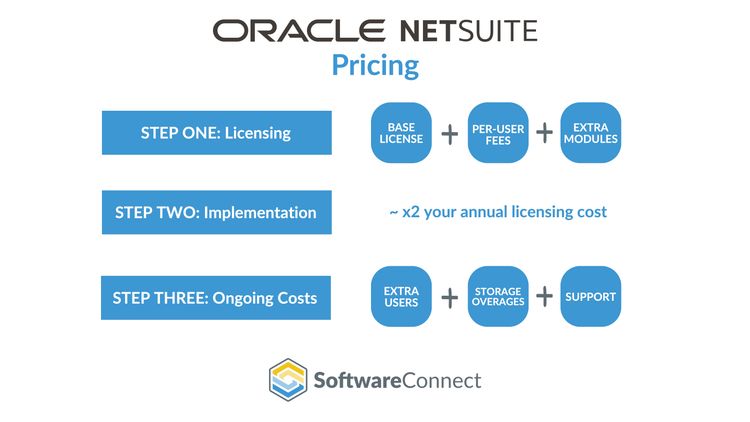
NetSuite’s cost boils down to three basic factors:
- Base license
- Per-user fees
- Extra modules
These are further packaged into industry bundles, available in Standard or Premium tiers:
- Starter
- Financials
- Manufacturing
- Distribution
- Services
- Food & Beverage
- Software Development/IT
Your base price depends on how many users you have. Starter covers up to 10 users, Standard up to 30, and Premium handles everything over 30.
| Bundle / Package | Starter Package (Up to 10 Users) | Standard Package (Up to 30 Users) | Premium Package (Over 30 Users) |
|---|---|---|---|
| Starter Pack | ✔ | ✖ | ✖ |
| Financials | ✖ | ✔ | ✔ |
| Manufacturing | ✖ | ✔ | ✔ |
| Distribution | ✖ | ✔ | ✔ |
| Services | ✖ | ✔ | ✔ |
| Food & Beverage | ✖ | ✔ | ✔ |
| Software Dev / IT | ✖ | ✔ | ✔ |
You pick the tier, pay the base package, and per-user licenses stack on top.
NetSuite ERP Pricing (Base License & User Costs)
NetSuite pricing for small businesses encompasses the Starter pack and Standard bundles. The Premium tiers are for larger companies needing more capabilities.
- Starter/Standard Bundles: ~$2,500–$5,000/month
- Premium Tiers: ~$5,000–$10,000/month
- Per-User Licenses: ~$129/user/month
These figures represent common ranges we see in real NetSuite quotes–not list pricing and not final costs.
If these costs seem too heavy, check out our roundup page on the Top NetSuite Competitors & Alternatives.
Biggest NetSuite Pricing Traps
Base Pricing Illusion
The above base prices assume a simple user mix, minimal customization, and basic workflows. Most teams will outgrow that baseline as additional modules become necessary. Beyond base license and user costs, NetSuite pricing depends on how broadly the system is used and your operational complexity.
User Mix & Access Creep
NetSuite factors in how many users you have and what they’re allowed to do in the system:
- Full-access users cost more.
- Employee self-service users cost less.
If you add the wrong mix early on, your licensing balloons quietly in the background. This usually doesn’t show up in the initial quote but rather in six months, when more teams need access, more workflows touch NetSuite, and more approvals live inside the system.
Implementation Shock
A quote that initially looks like “a few thousand a month” can turn into tens–or hundreds of thousands–once you factor in:
- Setup
- Data migration
- Workflows
- Integrations
Setup generally runs about twice your annual licensing cost but can scale higher or lower depending on complexity.
Lifetime Cost Creep
Ongoing ownership includes:
- Extra users
- Storage overages
- Premium support access
All of these live outside your base license, and most buyers don’t think about them until renewal time.
Learn more about hidden costs and ERP total cost-of-ownership in our article: How Much Does ERP Cost?.
NetSuite in the Broader ERP Market
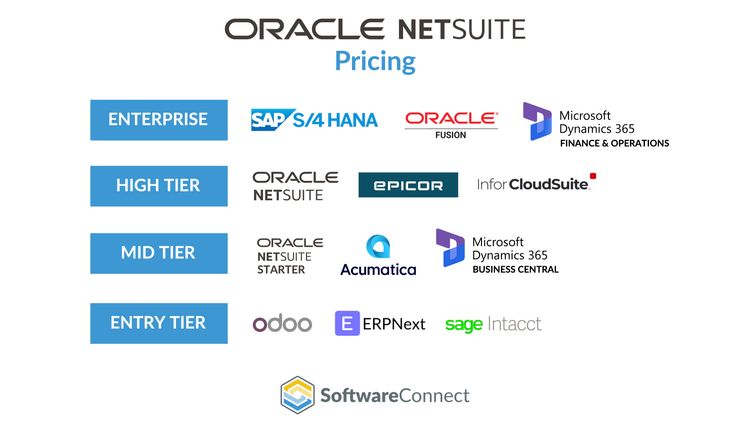
NetSuite pricing generally falls within these ranges of the broader scope of the ERP Market:
- Small Manufacturers (5-15 Users): $60,000-$250,000/first year
- Mid-Sized Manufacturers (25-50 Users): $150,000 to $600,000/first year
However, final NetSuite costs will ultimately depend on the modules, workflow complexity, number of users, chosen vendor for implementation and services, and negotiated contract terms or discounts.
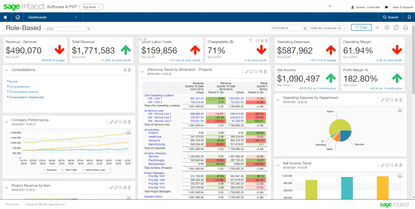
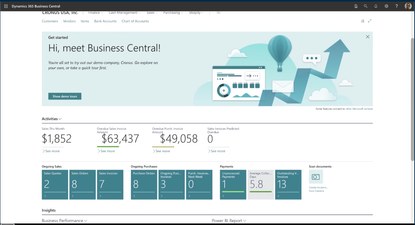
Companies needing more flexibility around users, modules, or rollout pace often evaluate alternatives like Acumatica alongside NetSuite to see which pricing structure better aligns with their growth plans.
Choosing the Right ERP
Anyone telling you they can give you exact NetSuite costs without looking at your setup isn’t giving you the whole picture. To make the right ERP decision the first time around, consider these factors during the evaluation process.
Don’t pick an ERP based on a month-one software quote. Your real cost comes from everything that happens after you sign:
- Data migration
- Workflow changes
- Integrations
- Implementation partner
- Your renewal in year two or three
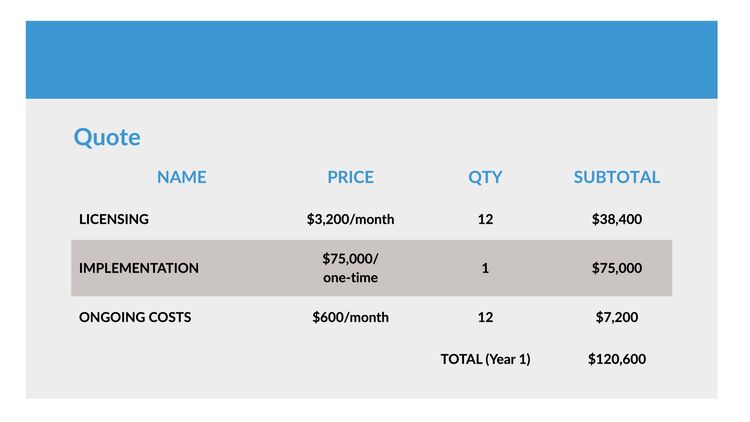
ERP vendors often recommend budgeting around 3% of annual sales for software. While this provides a rough starting point, this approach ignores profitability and operational complexity, leading to estimates that are misaligned with how companies actually budget.
Instead, try to calculate your ERP total-cost-of-ownership (TCO) across at least three years.
This should include every cost, like:
- Base subscription price
- Number of users
- Add-on modules
- Implementation & data migration
- Training
- Support
- Any customizations