
QuickBooks Enterprise vs. QuickBooks Online
QuickBooks has been a leading small business accounting software since its inception. Below, you’ll discover the differences and similarities between QuickBooks Enterprise and QuickBooks Online.
Quick Comparison
QuickBooks was developed by Intuit in 1998 as a double-entry accounting software for small businesses. This was a follow-up to the success of Quicken, which was more of a personal finance and home-office accounting solution. Today, it’s the most popular small business accounting software on the market. QuickBooks is not an ERP system, though Desktop Enterprise can offer some similar functionalities.
QuickBooks Enterprise Overview
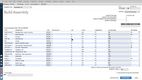
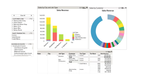
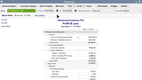
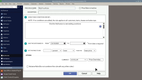
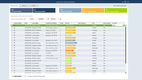
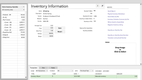
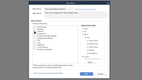

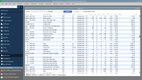
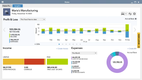
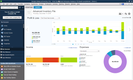
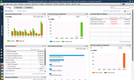

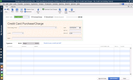
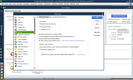
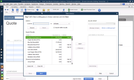
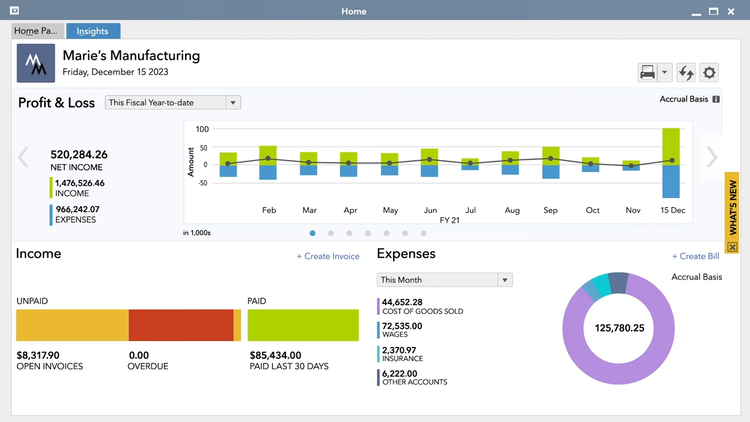
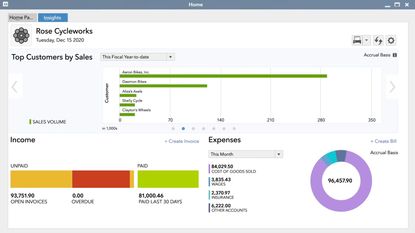
Although not an ERP, QuickBooks Desktop Enterprise does act as a light ERP software system. The all-in-one solution for business management allows smaller businesses to get ERP-level functionality at a fraction of the true ERP price. After Desktop Pro, Premier, and Mac were discontinued in 2024, Enterprise is the last QuickBooks Desktop product sold.
QuickBooks Enterprise includes financial management, sales orders, and inventory cost tracking features. It also offers 13 predefined user roles, which let you control each employee’s access to the program. These roles include accounts payable, accounts receivable, inventory management, payroll processor, and more.
The system also offers different industry-specific editions, including contractor, manufacturing, wholesale, nonprofit, and professional services. This is a major selling point, as each has specialized modules for its industry. QuickBooks Online is a general system without specialization in any field.
QuickBooks has a 30-user cap, suitable for growing small businesses. However, if your business requires multiple users with predefined roles, you may want to consider a different system. QuickBooks Enterprise offers both locally installed and cloud-hosted services, unlike QuickBooks Online, which requires choosing one or the other.
QuickBooks Online Overview
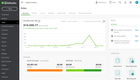




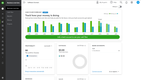

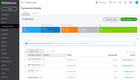

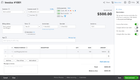
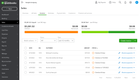
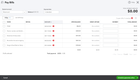
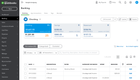
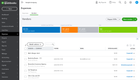
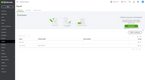
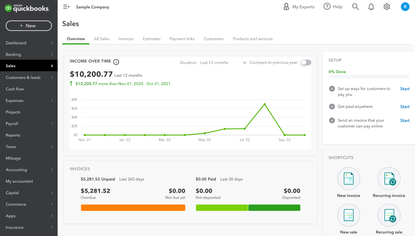
QuickBooks Online is a popular accounting software known for its affordable price and user-friendly interface. The software offers features that enable you to track sales and expenses, create estimates, manage customers, and collaborate with an outside accountant. The software also features an invoicing module, which allows you to have your customers pay via credit card or ACH bank transfer.
For any area where QuickBooks Online falls short, the QuickBooks Apps store has hundreds of apps and add-ons available. These add-ons typically allow for non-financial functionality that QuickBooks doesn’t provide in its base package. This includes expense management, time tracking, CRM, and cash flow forecasting. Due to the flexibility these apps provide, QuickBooks Online can be as simple or as advanced a program as you want.
How Much Does QuickBooks Enterprise Cost?
The price of QuickBooks Desktop Enterprise starts at $1,873/year. This is for the “Silver” version, which includes basic functionality but excludes payroll. The “Gold,” “Platinum,” and “Diamond” editions start at $2,210/year, $2,717/year, and $5,364/year, respectively. Each adds additional features, like multi-company management and advanced inventory.
All QuickBooks desktop options are now subscription-based; users can no longer purchase a version of the software and use it indefinitely.
How Much Does QuickBooks Online Cost?
The price of QuickBooks Online starts at $38/month for the Simple Start version, intended for freelancers. This version will create basic reports, track income and expenses, organize your receipts, and help you invoice customers. Pricing plans go up in cost and functionality, ending with the Advanced edition, starting at $275/month.
Many versions of QuickBooks Online will include a 50% discount for the first 3 months. A free 30-day trial is available for the Simple Start and Plus plans; however, discounted pricing will not be available if you use the trial.
Payroll is available as an add-on to any version of QuickBooks Online. This price for payroll starts at an extra $50/month plus $6.50/employee/month when bundled with Online. A Premium and Elite version of payroll exists for an increased monthly and employee/month cost. These versions cover more powerful tools and on-demand experts to assist you with daily tasks.
Feature Comparison
Compare QuickBooks Enterprise and QuickBooks Online Advanced. This powerful version of QuickBooks Online rivals QuickBooks Enterprise through advanced features not found in other versions of the online product, including smart reporting for charting and graphs that help make business decisions, accelerated invoice automation, and access for up to 25 users with user permission settings.
The following table shows a feature comparison between QuickBooks Enterprise and QuickBooks Online:
| Feature | QuickBooks Enterprise | QuickBooks Online | Quickbooks Online Advanced |
|---|---|---|---|
| Sales Order Management | Yes | Yes (basic) | Yes (basic) |
| Credit Card Processing | Yes | Yes | Yes |
| Fixed Asset Management | Yes | No | No |
| Excel Import | Yes | Yes | Yes |
| Bank Reconciliation | Yes | Yes | Yes |
| Inventory Management | Yes | Yes (basic) | Yes (more limited than Enterprise) |
| Bin Location Tracking and Bar Code Scanning | Yes | No | No |
| Multi-entity Accounting | Yes | No | No |
| Batch Invoicing | Yes | No | Yes |
| Sales Forecasting | Yes | No | Yes (basic) |
| Custom Reports | Yes | No | Yes |
QuickBooks Online features will be more basic or well-rounded, better suited for many businesses. QuickBooks Enterprise has tools developed for specific scenarios and industries over the years. QBE may lack the mobility of QBO, but it more than makes up for it with its comprehensive feature set.
Number of Users
The number of users may be an important deciding factor for your business as you ensure every staff member gets access to the program.
- QuickBooks Online Plus: Up to 5 users
- QuickBooks Online Advanced: Up to 25 users
- QuickBooks Enterprise: Available in 1-10 or up to 40 users (Enterprise Diamond is sold in increments of 1-10, 20, 30, and 40 users).
Remember that these are for concurrent users, or users that require access simultaneously. It’s possible (and even encouraged) to have users share the same logins in order to save on software expenses. However, this may not be the type of audit trail your company desires.
While QuickBooks Online can handle a high volume of users (depending on your version), it performs best when using 5 or fewer users. If you require more, you’ll need the Advanced plan that offers 25 users. Beyond that, your needs have likely exceeded what QuickBooks Online will offer you long-term, and it may be time to consider upgrading to an ERP.
Where Does Intuit Enterprise Suite Fit In?
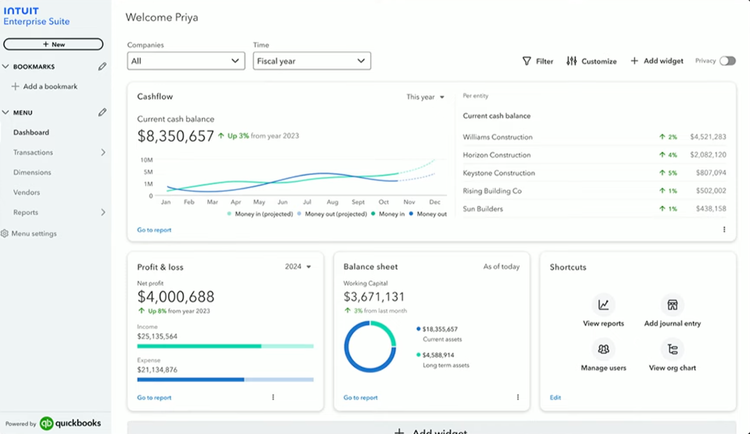
In September 2024, Intuit launched Intuit Enterprise Suite, a cloud-based light ERP aimed at businesses that are outgrowing QuickBooks Online. This is likely Intuit’s long-term replacement for Desktop Enterprise.
IES runs on the same underlying platform as QuickBooks Online but adds true multi-entity consolidation, a multidimensional chart of accounts, and higher data capacity. The launch came days before Intuit stopped selling Desktop Pro and Premier, which is a strong signal that Enterprise is the next desktop product to go.
That said, it’s only suitable for multi-entity service or construction companies, and it’s a lot more expensive. Still, if neither QBE nor QBO quite fits your business, IES is worth weighing as a third option. See our full Intuit Enterprise Suite product profile for more info.
QuickBooks Enterprise vs QuickBooks Online: Which is Best?
After reviewing and testing both software options, it really depends on your business. QuickBooks Desktop Enterprise generally takes the lead for larger small businesses because of its in-depth features and scalability. But QuickBooks Online is usually the better option for most small businesses—it has more flexible pricing and feature options that make it more accessible for companies just needing a simple accounting platform. Plus, its cloud-native architecture makes it accessible from anywhere with internet access.
QuickBooks Desktop Enterprise caters to businesses looking for deeper insights, detailed reporting, and higher user limits. So, when it comes to intricate financial management, predefined user roles, and capacity for growth, QuickBooks Desktop Enterprise does hold an edge. That said, businesses just starting or those prioritizing ease-of-use will probably still opt for Online. Plus, with Desktop slowly being discontinued, it’s hard to recommend it for new users.
Check out our complete roundup of the best accounting software for other options, or read more about the best QuickBooks alternatives.